
Custom suites/albums
- This topic has 37 replies, 11 voices, and was last updated 1 week ago by
 Blaize.

-
AuthorPosts
-
2. October 2026 at 01:24 #14569
I didn’t see a thread about this already. Does anyone else like making them? I really enjoy taking scores and trying to make a good, fluid arrangement with a beginning, middle, and end. It’s like trying to put a puzzle together. How do you make yours? Chronological order? 10 minutes, 20, 30? Best tracks first or last? Sforzando or slow start? There are AI instrument removers now; do you play with those? Short tracks or long tracks? Do you repeat tracks/alternates?
2. October 2026 at 07:40 #14570Honestly, I am not a fan at all of fan edits. Even though from time to time I heard some nice fan made suites of scores on YouTube, I always found that kind of disrespectful against the original work and the composer. If I want to do something creative I rather write my own music, however lame or primitive that is. But it is my own and not a cannibalization of somebody elses work.
I know, this remix and adaptation thing is some kind of postmodern artform in itself. But I already wasn’t a fan of that when in the 90s these rap-adaptations of classic pop songs came up. Of course for every point there are exceptions.
But I don’t want to appear disrespectful to your hobby here. It’s just my personal view for myself and why I don’t do it. Of course such kind of deconstruction of a musical work can give you interesting insights into the structure and architecture of a musical piece. That’s the valuable part I see.
2. October 2026 at 09:09 #14572I don’t do real custom suites of existing material. I sometimes do best of of existing tracks but no fading or something. More in the vain of Thor’s whittling down. But actually I rarely do that except for compilations for a few friends that still care 😉
I did some remix fun some years ago.I sometimes do track extractions of scores that are not available at all. Must mostly the tracks that are generally standalone without much sfx like main titles or end credits. Or from silent movie scores that have no release outside the film itself. But I don’t really edit them beside splitting into smaller tracks if there are silent gaps already.
2. October 2026 at 09:59 #14574I do this all the time. Not because I want to, but because I have to, if I am to have any kind of enjoyment of the album. By now, I’ve pretty much “whittled” down all the albums in my collection that needed it the most, about 300 out of 3000. So 10%. Probably several more that need it, but it’s something I’ll have to do down the line, when I get to them.
I take screenshots of the playlists, and when I get a new computer, I need to re-configure them based on those. Which I recently did, after having to re-install a new hard drive on my old laptop, and hence re-install all my music files. Lots of work!
Since it’s not usually something I enjoy to do, whittling in my case basically means removing tracks to get it down to a decent length. Once in a rare while, I also shuffle a couple of tracks around to make for more fluid listening. But I don’t mess around with it further, like micro edits or AI removers (which cost money, anyway, don’t they?). Above my paygrade.
As we discussed in this thread, I’m of the old school that prefer to get an album in my hands that is sufficiently curated and whittled down by the composer or producer.
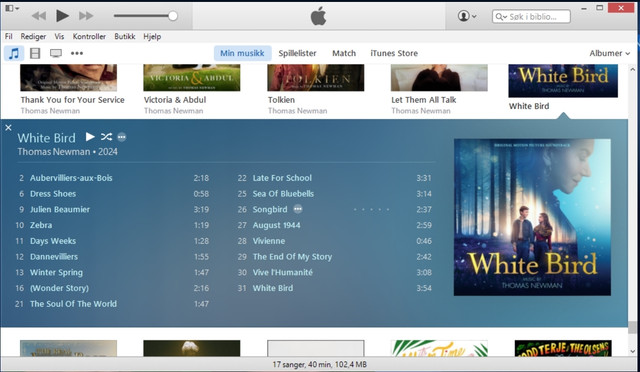
Here’s an example of an album where I’ve BOTH removed several tracks, AND shuffled a couple of tracks around to make it work. As a result, Thomas Newman’s WHITE BIRD went from being a ‘snoozefest’ that I had no intention of ever playing again to a ‘pretty damn good’ album I look forward to revisiting:
 2. October 2026 at 10:54 #14575
@Thor: Btw, did you ever try the iTunes Playlist export and import? I recenlty tried that out of curiosity. It exportes a .txt file and probably as long as all the files are in the library you can actually re-import it intact. Maybe saves screenshots.
2. October 2026 at 10:59 #14576Honestly, I am not a fan at all of fan edits. Even though from time to time I heard some nice fan made suites of scores on YouTube, I always found that kind of disrespectful against the original work and the composer. If I want to do something creative I rather write my own music, however lame or primitive that is. But it is my own and not a cannibalization of somebody elses work.
Yes your hobby is much more interesting than mine; I have no imagination for writing my own music. But as you said it can teach you a lot about how the music is structured and how a lot of very long scores are founded on some really basic ideas that the composer relies on to get all that work done. I do the same with books, I have no aptitude for writing my own stories but enjoy reading non-fiction stories and writing summaries of them. It has taught me a lot about how good books are edited and conceived, and I remember a lot more that way.
To me, it’s no different from what Conrad Pope did with the “Tribute to Film Composers”: just a fun way of playing around with music you enjoy.
Since it’s not usually something I enjoy to do, whittling in my case basically means removing tracks to get it down to a decent length. Once in a rare while, I also shuffle a couple of tracks around to make for more fluid listening. But I don’t mess around with it further, like micro edits or AI removers (which cost money, anyway, don’t they?). Above my paygrade.
There are free ones like MVSep. If I have two string tracks which I want to string together, but one has percussion, I might use it to strip the percussion out and get one long string track. That of course is more involved than what you do with your reshuffling.
2. October 2026 at 11:20 #14577Yes your hobby is much more interesting than mine; I have no imagination for writing my own music.
I wouldn’t say that. I guess, it is just a slightly different perspective on things. And like you said. You might be getting valuable insights on the compositions and be able to enjoy them more than I ever could.
And probably us both will never experience the joy of musicians actually playing the music in an orchestra.
Everyone has his or her own way. And that’s good.
2. October 2026 at 12:24 #14580@Thor: Btw, did you ever try the iTunes Playlist export and import?
It’s something I will definitely look into next time. I did use an ‘import library’ file this time, but the playlists didn’t follow. I don’t think they’re embedded into the files when I make them. Also, they’re technically not separate playlists — I just edit them straight in the album.
There are free ones like MVSep. If I have two string tracks which I want to string together, but one has percussion, I might use it to strip the percussion out and get one long string track. That of course is more involved than what you do with your reshuffling.
It’s definitely a tool I would have looked it into if it had been readily available (and free) when I did that John Williams television music podcast series — just to remove the sound effects. But the sound quality was so bad to begin with, it would have removed, or deteriorated, the music as well, I think.
But beyond use like that, I don’t want to mess with the music recording itself. Most of the time, it sounds fine the way it is. But if there had been an AI way to improve, say, the sound quality of something like Michael Small’s MOUNTAINS OF THE MOON, I’d be interested.
2. October 2026 at 12:49 #14581just to remove the sound effects. But the sound quality was so bad to begin with, it would have removed, or deteriorated, the music as well, I think.
My impression is that these tools work best if the sound quality is already good and in stereo because of the better panorama separation. I guess sound effects are difficult because they include so many different frequencies that also could be drums or something. Plain vocals in a clear mixed pop song or a narrator on top of music can work pretty good.
2. October 2026 at 13:33 #14582I’ve noticed lately, when digging out an old CD for a replay, I’ve sometimes left the track number whittle note that I did previously, in the CD case and, upon replay, would do it a bit differently this time around!!
Some tracks I’d kept (on various mp3 player/device) no longer appealed to me as much, and other tracks I’d dropped sounded much better to my ears.
So your mood and that particular moment in time is also a factor, certainly for me.
That’s why I still love returning to the actual CD for a fresh new listen/experience.2. October 2026 at 14:25 #14587I usually don’t create custom suites from albums, and I don’t usually edit or whittle albums in any way. I generally tend to prefer to listen to whole albums (or compositions… if there’s more than one “composition” or work on an album, I often listen only to one). But I know a lot of people enjoy whittling and re-editing, and remixing and whatnot with their music.. well, that’s fine… whatever makes you happy.
There are a few albums where I made playlists for a variety of reasons… I always had a playlist for Morricone’s original soundtrack album for THE UNTOUCHABLES (even before “playlists” I always programmed my CD player to a certain order), as the original album order was musically just “wrong” and it really annoyed me. Funny thing is, Morricone must have thought so to, because he eventually changed the order for his “Musiques De Films 1964 – 2015” album to exactly my playlist order. 🙂
I do sometimes spontaneously program a playlist when I listen to something “on the fly”, say, I program an overture, then a concerto, then a symphony or a film score or something like that, sometimes abbreviated, sometimes in full… but that’s just spontaneous and not “saved” anywhere but just added to the listening sequence.
The actual playlists I do have are all in a separate playlist folder, so they exist independently and are not bound to a particular piece of software.
2. October 2026 at 15:14 #14590I sometimes skip songs if they are not related to the actual score and share the same album.
My most playists are often playlist that I set to album view where I group related stuff for quick access. Like having all Alan Parsons Project albums, everything Star Wars related or similar. But not actual scores. An exception is maybe a chronological order just to compare with the non chronological album.
I do have some playlists for stuff I haven’t yet listened to or should listen to again so I don’t forget them in the “digital nirvana”.
Funny thing is, Morricone must have thought so to, because he eventually changed the order for his “Musiques De Films 1964 – 2015” album to exactly my playlist order. 🙂
Was he really involved in that album? 😉
2. October 2026 at 15:52 #14602As far as I know actually yes, though I don’t know to which degree… the box set was quite a long time “in the making” before it was released. I would suppose Morricone’s “involvement” basically consisted of “approving” the set.
2. October 2026 at 16:55 #14608You look very much like Ennio Morricone.
2. October 2026 at 17:04 #14610🙂
2. October 2026 at 17:24 #14613It’s the mileage.
2. October 2026 at 17:51 #14615“You look very much like Ennio Morricone”
🤣🤣
2. October 2026 at 19:56 #14628This is a topic on which I could chat about endlessly! For almost 10 years, I’ve been in the habit of not only creating custom shorter albums of lengthy scores but also using Garage Band to edit and create suites. I have close to 160 custom albums, many of them are “highlights” albums, gathered by genre, by franchise or by composer. This goes beyond playlists in iTunes as I will edit the metadata on tracks and on the files created in Garage band so these custom albums are listed in the Music on my iPhone alongside officially released albums. For example, I have a multi-volume “Fantasy & Science Fiction” series of “albums”, delineated by decade, some decades having multiple volumes. My custom albums never exceed CD length, 75 minutes max, so they could be burned onto disc as well and enjoyed.
As I’ve mentioned in FSM threads, in the last few years when putting together shorter versions of lengthy scores for my own listening pleasure, I place myself at the time of when the movie was released and set my limits by the media format, re-use fees, marketing demands, composer’s other albums, etc, inherent in that time. For example, my custom “LP” of Goldsmith’s THE CHALLENGE is 45 minutes as in 1982 that would have been close to the max of an LP length. And tracks are sequenced so each “side” of the LP has its own ebb and flow and a banger track ending Side 1 so that you want to flip over the LP or cassette to keep listen. My favorite examples of this type of OST are FIRST BLOOD and OUTLAND LP’s. See below for my example:
The Challenge (Custom Album Edit) – 45 min
Side A
Main Title
The Wrong Sword (Alternate Take)
Half An Equal
The Traitor
“Let’s Talk”
No DefenseSide B
“Can’t We Do It?”
Over The Top / Fish Market
“Stay With Me”
Surprise Visitor / Forced Entry
“As You Wish” / End Title2. October 2026 at 20:26 #14629I place myself at the time of when the movie was released and set my limits by the media format, re-use fees, marketing demands, composer’s other albums, etc, inherent in that time.
Wow, that’s fascinating, Tom. I do that, too, while listening, but I’ve never done it as far as “album creation” is concerned. What a cool idea/project!
2. October 2026 at 21:02 #14631Thanks much, Thor! Yeah, I’ve found that in recent years I’m preferring shorter album run times and my highlights compilations, as it maximizes my listening time. If I only have around 90 minutes of free time, I’d rather listen to two 45 minute albums rather than one 75 minute album or just one 75 minute compilation that has tracks from 15-16 scores.
I’m also not precious about chronological order on score albums either, as I started to find it boring that I would know what cue was next simply by knowing the movie. I don’t want the narrative of the movie to play in my head as I listen, I just want to enjoy the best musical highlights of the score, in an interesting sequence. If the best cue of a score is track 2 or track 10 on any given album, it doesn’t change the fact that it’s a great cue and I really don’t care if it’s in film order. I also don’t want to wait 45 minutes of listening time to reach that great cue!
2. October 2026 at 21:20 #14633The Challenge is an interesting case, cos there never was an LP at the time of the films’ release.
Now I’m sure if there had been, Goldsmith would have fashioned a cool 35-40 minute album ala Capricorn One, Outland and The Swarm etc.
But having recorded the music off the film, back in the day, to get to hear the music multiple times, The Challenge (like many scores from that period) didn’t have a duff track within it.
So I was unwilling to sacrifice ANY music from the film, when it was finally released (on CD).
I know a lot of latter day scores feature far too much ‘filler’ music and deserve a good whittle, but many of the great scores of the 60s, 70s & 80s are required listening in complete form.2. October 2026 at 21:58 #14637Tell that to Thor. 😉
2. October 2026 at 23:08 #14638Haha. He knows we’re complete opposites when it comes to listening to score albums and how much more I want from my favoured composers, compared to his less music stance.
2. October 2026 at 23:11 #14639Aye! But you’re not adverse to a whittle now and then.
2. October 2026 at 23:34 #14641Hey Tom, sometimes I think of it that way too. Someone mentioned Untouchables earlier; I watched the film and felt like even though it was 1930s America, the music had a very European structure with few cues and lots of theme variations. My own edit took a lot of similar thematic ideas and put them together; for instance, the main theme.
Batman Forever had an operatic feel so I wanted each track to feel like a symphonic movement; this is about eight tracks combined.
A modern score like Beltrami’s Logan is just a bunch of electronic sludge thrown in a blender, so I overlaid three versions of the same track (all with different electronics) as best I could for this track. It’s fun to think of the scores as being their own little worlds with different rules about how they’re arranged.
3. October 2026 at 00:20 #14642Since I always “hated” LPs — even back in the day when they were my only true source of music — I sure never had the craving of creating anything that resembles an old-school LP out of an actual full film score (not to mention that I don’t enjoy spending my time editing and pasting and mastering other people’s music… even though I know my way around the tools).
However, if someone else wants to carve up a composition, stitch it newly together, or reinvent it, that’s their dance, their thing, and I always more or less say that’s how art should be approached: interactively. Personally, I admit, I’m a bit like GerateWohl in that I tend to just prefer to hear the music as intended, and I cannot myself think of a single composition by a great composer that was improved on through copy-paste by an outsider (especially not a laymen), so I rarely feel the need to do it myself (unless perhaps a release is musically nonsensical).
I usually don’t “edit-copy-paste-cut” other people’s music, but that’s because: either I like the music (in which case I don’t have to) or I don’t like the music (in which case I won’t be spending time with it). Also, the little time I have for music I prefer enjoying — listening — to it over editing or tinkering with it, but that’s just my own personal preference.
What I do enjoy, however, is when there are actual custom suites written (by folks who can at least read and write music) from film music, especially if they are not merely a medley of the highlight film themes. Recordings of those I enjoy listening to, like Bernard Herrmann’s concert suites, for example, which are exemplary.
3. October 2026 at 01:51 #14643@Wesley That’s definitely a thematically sound way to reassble The Untouchables, especially since most of Morricone’s scores are all based around 2-3 themes that are repeated with some variations. He doesn’t go for the “through composed” style of a Williams, so it’s easier to collect a few presentations of each theme together.
@Nicolai Since so many scores as heard in their accompanying films are already edited, cut, copied and pasted around, such as in ALIENS, PREDATOR and DIE HARD, these aren’t really comparable to a concert work or pop/rock album. The composer might have composed “wild cues” to be used anywhere or not written any music for a specific sequence, which then has cues tracked in from elsewhere.
And also what scenes are scored is determined by the director and not the composer so there might be no music for 30 minutes yet the last cue and next cue are the same theme repeated, meaning that on chronological presentation on album you get the same theme repeated back-to-back. For me, I hate repetition! It’s simply acknowledging that film scores aren’t like any other genre of music and thus an album made from a film score can honestly be presented in any fashion.
3. October 2026 at 10:19 #14644Since so many scores as heard in their accompanying films are already edited, cut, copied and pasted around, such as in ALIENS, PREDATOR and DIE HARD, these aren’t really comparable to a concert work or pop/rock album. The composer might have composed “wild cues” to be used anywhere or not written any music for a specific sequence, which then has cues tracked in from elsewhere.
Sure, that’s why I generally (“generally” referring to a “general” rule and tendency, not an “absolute”) tend to prefer to listen to film scores as the composer originally intended them to be, not how they ended up in the movie.
I would say most film scores are not very interesting to listen to as music, so it’s just select composers whose music really interests me. I tend to gravitate towards composers like Alex North, Jerry Goldsmith, Leonard Rosenman, etc., and these very much approached their film scores with classical music architectures in mind, so their scores generally benefit from being more or less listened to the way they were composed. That’s because their compositional background led them to compose their works “through”, and not moment by moment and scene for scene. As far as repetition is concerned, that’s a device like any other: if it serves the dramatic structure of the music, great, if not, not. But far too often I’ve seen carelessly produced soundtrack albums where obviously musically ignorant people re-arranged cues more or less like a pop album: a slow cue here, a fast cue there, and so on… get some variety, without regard to the actual musical structure. If, on the other hand, that’s done with some actual musical sense (like Christopher Young, for example, arranges his albums), well, I’m all for it.
Last, but not least, as I said: I think anyone can and should listen to music the way they want to. If people have fun editing their albums, go for it. If people have fun whittling down their albums, by all means, no one is stopping you. If people are only happy if their film scores are complete and chronological, that’s fine. If people are only happy if the film score is short (like an LP) and get impatient with longer works, fine too. Today’s digital world allows anyone to listen to music any way they want to, so that’s actually pretty cool. No more “one size fits all”.
I don’t fall in any particular “camp”, I just usually don’t invest the time to carefully analyze an album to re-arrange or edit or whittle the music… I either like what I hear or don’t. If I think an album is “too long”, chances are I won’t like it in shorter form either.
Last but not least, not all film scores are alike. There are the classically structured scores by people like Goldsmith or North, these tend to have a musical architecture that gets easily fractured if you carelessly re-arrange the cues (even though sometimes cues can be re-arranged for musical reasons… for example, the cue “The Landing” in Goldsmith’s ALIEN is one of the first cues in the movie and on the film score presentation, but it’s actually a “musical resolution” cue that — for purely musical purposes — should may be placed near the end, perhaps even the penultimate cue…. maybe I’ll make a playlist and try it out. Then again… I can just press “play” and place the cue towards the end on the fly. 🙂 ).
Then there are scores by Ennio Morricone, that are not always composed “dramatically” to picture but more themes and variations. You can often easily arrange those around, or skip some, or add some… and make your own albums out of them. Not all Morricone scores are always best when you listen to all cues in one sitting. I enjoy very much the way FSM presented DAYS OF HEAVEN, which out of the box already gave you three distinct variations to listen to the score (of which, ironically, the original soundtrack album presentation is the least interesting).
Some scores by Hans Zimmer are more “mood” setting pieces, there is no strict musical architecture, so the way Zimmer arranges his albums, often with long cues segueing into each other, I very much enjoy that, so his soundtrack albums are often not released compositions but arranged “concept albums”, which I enjoy very much.
So it all depends, it’s a case by case thing. I sure don’t mind if people enjoy editing their own albums. It’s just that I personally don’t have that particular time or inclination, and unless something jumps right out at me and screams “WRONG”, I prefer to spend my own time listening to music rather than editing it down to my own personal needs. But that’s just me.
Roger Ebert once famously noted: “no good movie is long enough and no bad movie is short enough”, so that goes for music as well as far as I’m concerned. No good composition (or album) is long enough and no bad composition is short enough.
5. October 2026 at 16:21 #14729There are cases where I want to hear a certain number of scores in one sitting, but pressed for time. To solve this, I’ve been in the process of making custom compilation sets featuring “digest” versions of related scores. One set features scores from Akira Kurosawa’s films, another for Akira Ifukube’s Godzilla scores (divided into two volumes) and another for his science fiction works (will also be divided into two). They’re all still WIPs, with a couple more I’ll be working on in the future.
Since part of my Godzilla compilation is complete, I’ll provide the track list of the first disc as an example.
Akira Ifukube Godzilla Film Music Anthology, Disc 1:
“Godzilla” (11/03/1954)
01. Main Title (DB-1 M-1·2 [DB-1 M-2 + DB-1 M-1])
02. Eiko-Maru Sailors’ Rest ~ Sinking of the Eiko-Maru (DB-2 M-3)
03. Anxiety of Odo Island (DB-7 M-5)
04. Kagura of Odo Island (DB-10 M-6)
05. Storm at Odo Island ‒Take 1‒ (DB-11 M-7)
06. Theme of Odo Island (DB-15 M-9)
07. Frigate March I (DB-20 M-11)
08. Godzilla Lands (DB-30 M-14=A)
09. Intercept Godzilla (DB-34 M-16)
10. Godzilla’s Fury (DB-39 M-18A [DB-14A M-A’])
11. Godzilla to Tokyo Bay (DB-44 M-18D [M-C])
12. Pursue Godzilla (DB-44 M-18D [DB-1 M-1])
13. Oxygen Destroyer (DB-47 M-20)
14. Godzilla Under the Sea (DB-52 M-22)
15. Ending (DB-53 M-23)“King Kong vs. Godzilla” (08/11/1962)
16. Main Title (DB~1 m-1)
17. Seahawk’s Crisis (DB~2 m-4)
18. Seahawk S.O.S. (DB~3 m-5)
19. Faro Island (DB~3 m-6)
20. Fumiko’s Anxiety (DB~4 m-9)
21. Godzilla Resurrected (DB~4 m-10)
22. Cry of the Devil (DB~5 m-11)
23. Demon of the South Seas (DB~6 m-13 + DB~6 m-13A)
24. Terror of Godzilla (DB~8 m-16)
25. Operation Burial Preparation (DB~9 m-18)
26. Operation One Million Volts Preparation (DB~10 m-20)
27. Operation Burial (DB~10 m-21)
28. Operation One Million Volts I (DB~10 m-23)
29. King Kong Appears in Tokyo (DB~11 m-25)
30. King Kong Transport Operation (DB~12 m-27)
31. King Kong vs. Godzilla II (DB~14 m-29B)
32. Ending (DB~14 m-30)“Mothra vs. Godzilla” (04/29/1964)
33. Main Title (DB-1 M-1-2)
34. After the Storm (DB-1 M-2)
35. Shobijin Theme (DB-2 M-5-2)
36. The Shobijin’s Recollection (DB-3 M-6)
37. Dome Ignition (DB-4 M-10)
38. Mysterious Radioactivity (DB-5 M-11)
39. Godzilla Emerges (DB-5 M-12)
40. Godzilla and Nagoya (DB-5 M-14)
41. Evil Spirit Purification Ceremony (DB-7 M-17)
42. Mothra’s Departure (DB-7 M-18)
43. Operation B Electrical Discharge Attack (DB-10 M-23)
44. Mothra vs. Godzilla II (DB-12 M-25)
45. Ending (DB-12 M-26)In addition, I’m also making a custom album for Ifukube’s “The Burmese Harp” (1956), combining the eighteen surviving cues (pretty much all outtakes) with all usable cues lifted directly from the film itself to create the most complete representation of the score possible. As of now, it consists of twenty-six tracks. The score itself consists of a little over 35 cues.
5. October 2026 at 22:07 #14735Super cool, thanks for sharing these track lists for your custom albums! I created three highlights compilations for the GODZILLA series, one each for Showa, Heisei and Millennium eras. Below is my track list for the Heisei era, since it was already sitting in my iTunes due to an update I was making to it:
GODZILLA: Highlights from the Heisei Era – 76 minutes
1.End Titles from “Godzilla vs King Ghidorah” (1991)
2.Main Title from “Godzilla 1984 (aka The Return of Godzilla)”
3.Self Defense Forces March II from “Godzilla 1984 (aka The Return of Godzilla)”
4.Destruction of Nuclear Plant from “Godzilla 1984 (aka The Return of Godzilla)”
5.Super-X from “Godzilla 1984 (aka The Return of Godzilla)”
6.Godzilla’s Farewell from “Godzilla 1984 (aka The Return of Godzilla)”
7.Godzilla Ending from “Godzilla 1984 (aka The Return of Godzilla)”
8.Super-X2 from “Godzilla Vs. Biollante” (1989)
9.Love Theme from “Godzilla Vs. Biollante” (1989)
10.Bio Wars from “Godzilla Vs. Biollante” (1989)
11.King Ghidorah Attacks Fukuoka from “Godzilla vs King Ghidorah” (1991)
12.Mesa March from “Godzilla Vs. Mothra” (1992)
13.Imago Mothra Emerges from “Godzilla Vs. Mothra” (1992)
14.Imago Battra Emerges and The Three Monsters’ Death Battle from “Godzilla Vs. Mothra” (1992) (yes, I combined these 2 cues)
15.Main Title from “Godzilla Vs. MechaGodzilla II” (1993)
16.G-Force March I from “Godzilla Vs. MechaGodzilla II” (1993)
17.Rolling Title from “Godzilla Vs. MechaGodzilla II” (1993)
18.Main Title from “Godzilla vs. SpaceGodzilla” (1994)
19.Godzilla Theme 1994 from “Godzilla vs. SpaceGodzilla” (1994)
20.Requiem from “Godzilla vs. SpaceGodzilla” (1994)
21.Hyper Battle Area from “Godzilla vs. SpaceGodzilla” (1994)
22.MOGERA Ready to Die from “Godzilla vs. SpaceGodzilla” (1994)
23.Main Title: The Destruction Of Hong Kong from “Godzilla Vs. Destoroyah” (1995)
24.Super-X3 Attacks from “Godzilla Vs. Destoroyah” (1995)
25.Maser Tank Cryogenic Attack from “Godzilla Vs. Destoroyah” (1995)
26.Requiem from “Godzilla Vs. Destoroyah” (1995)
27.Ending Title from “Godzilla Vs. Destoroyah” (1995) -
AuthorPosts






- You must be logged in to reply to this topic.